“You Are Not Saved by the Sermon; You Are Saved by the Eucharist” Kalaymyo (8.2. 2026)

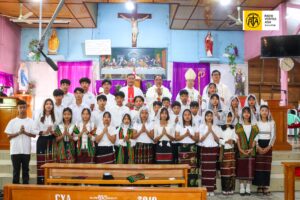
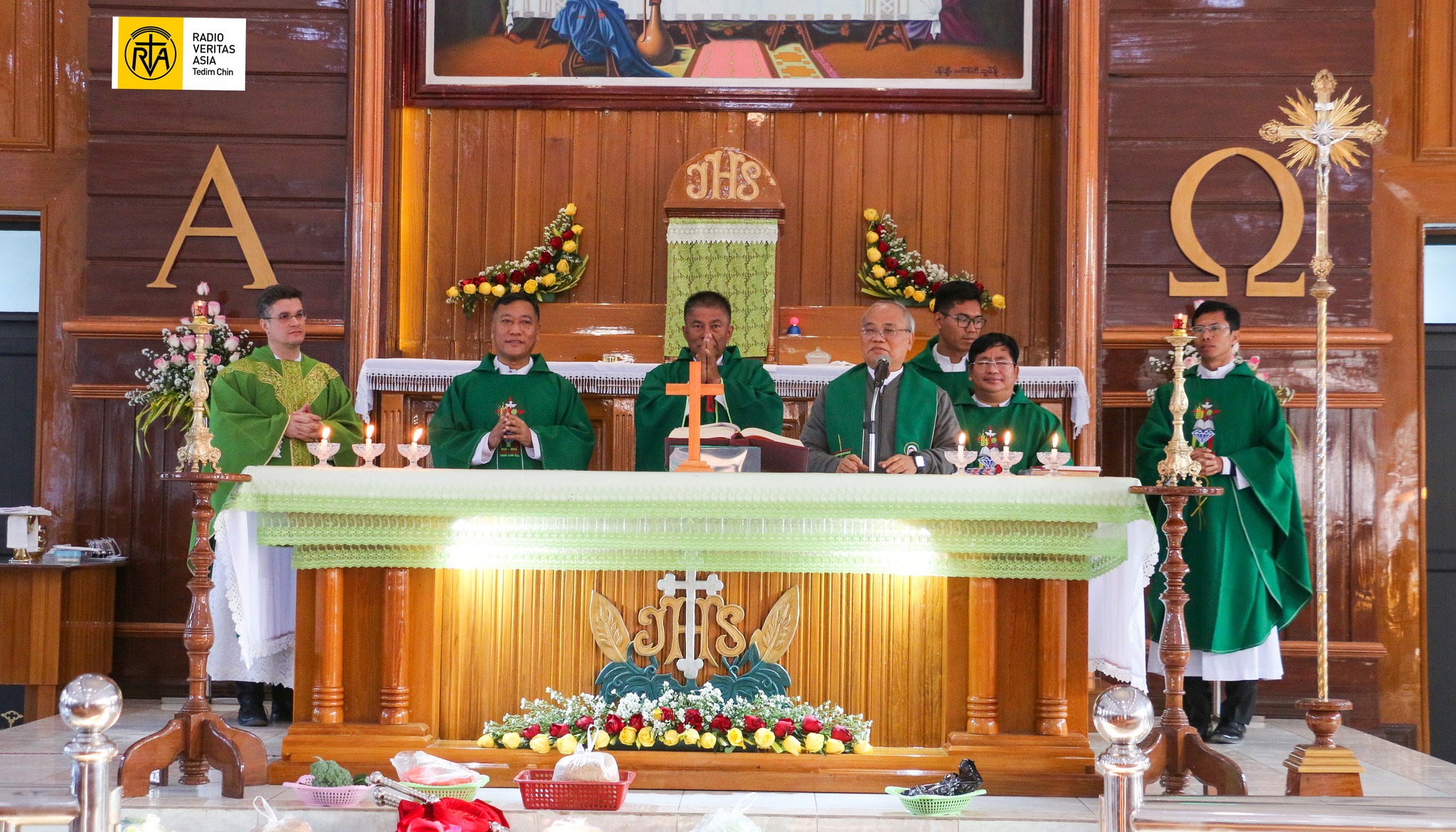
On the Fifth Sunday in Ordinary Time, Rev. Fr. John Aye Kyaw of the Mandalay Archdiocese presided over the Holy Eucharistic Celebration at St. Mary’s Cathedral, Kalaymyo. Concelebrated by six priests and attended by approximately one thousand faithful, the liturgy became a profound catechesis on the centrality of the Eucharist in the life and growth of the Church.
Preaching on Matthew 5:13–16 — “You are the salt of the earth and the light of the world” — Fr. John situated Christian witness within its sacramental foundation. The call to be “salt” and “light,” he explained, is not merely moral exhortation but flows from communion with Christ, who is truly present in the Eucharist. Missionary fruitfulness, therefore, cannot be separated from Eucharistic fidelity.
He posed a historical question that invited theological reflection: Why did large numbers of people in Chin State embrace the Catholic faith even though Protestant missionaries had arrived nearly thirty years before the missionaries of the Paris Foreign Missions Society (MEP)?
While acknowledging the eloquence and scriptural preaching of Protestant pastors, Fr. John noted that many of the early MEP missionaries struggled with the Chin language and were not renowned for rhetorical skill. Yet the Catholic Church in Chin State steadily grew.
The explanation, he proposed, lies not primarily in preaching but in sacramental reality. “You are not saved by the sermon; you are saved by the Eucharist,” he declared. Salvation, he emphasized, comes through participation in the Paschal Mystery made present in the Holy Mass. Preaching prepares the heart, but it is Christ Himself — substantially present in His Body and Blood — who sanctifies and saves.
Citing Luke 22:19 — “Do this in memory of me” — Fr. John underscored that the Eucharist is not a devotional option but the Lord’s own mandate to the Church. In every celebration of the Holy Mass, the once-for-all sacrifice of Calvary is sacramentally re-presented, and the faithful are drawn into communion with the living Christ. The Church grows wherever the Eucharist is faithfully celebrated, for the Eucharist is both the source and summit of ecclesial life.
Quoting John 6:54 — “Whoever eats my flesh and drinks my blood has eternal life” — he reminded the faithful that eternal life is not an abstract promise but a sacramental gift. The missionary vitality of the Church in Chin State, he suggested, flowed from the unwavering commitment of the missionaries to celebrate the Holy Mass, even amid linguistic limitations and material hardship. Their ministry was Eucharistic at its core.
Fr. John recalled his first arrival in Tedim in 1977 as a philosophy seminarian, when the Catholic population in Chin State was still small. Today, the Diocese of Kalay numbers more than 60,000 faithful. He described this remarkable growth as a visible manifestation of divine grace and as the fruit of a Church rooted in the Eucharistic mystery.
The homily concluded by returning to the Gospel image of salt and light. Authentic Christian witness, he said, arises from Eucharistic communion and expresses itself in charity. As the missionaries once shared their lives with the Chin people, so too must today’s faithful become living signs of Christ’s presence through service to the poor and those in need.
Rev. Fr. John Aye Kyaw, a senior priest of the Mandalay Archdiocese and former Rector of St. Thomas Seminary, Mandalay, has played a formative role in the priestly formation of the Kalay Diocese; more than thirty priests ordained for the Diocese received their training under his leadership.
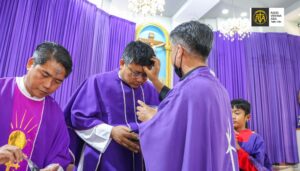
He was invited by His Excellency Bishop Felix Lian Khen Thang (Bishop of Kalay Diocese) to serve as retreat preacher for the Bishop and priests of the Kalay Diocese from 8 to 12 February 2026. He arrived in Kalaymyo on 7 February and celebrated the Sunday Mass at St. Mary’s Cathedral the following day.
At the conclusion of the Mass, Msgr. John Deng Cin Khup, Parish Priest of St. Mary’s Cathedral, expressed gratitude to Fr. John and formally introduced him to the faithful.